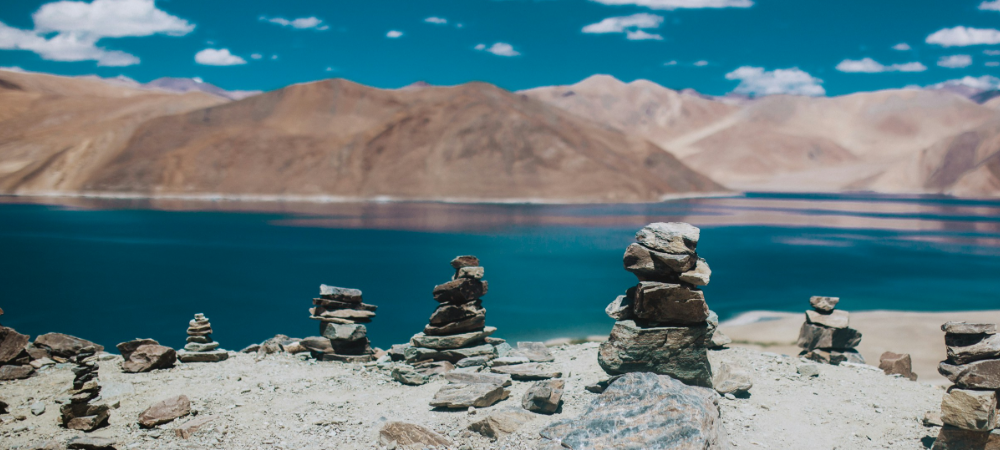

While Ladakh’s towering mountain passes test human endurance, its vast, carved river valleys reveal the region's true soul. Tucked between the jagged ramparts of the Himalayas and the Karakoram range, these valleys are dramatic worlds of contrast - where roaring glacial rivers cut through moonlike deserts, ancient monasteries cling to crumbling cliffs, and emerald-green oases flourish against bare rock.
Nubra Valley - The Valley of Flowers and Cold Sands
Reachable by crossing the high gap of Khardung La, Nubra Valley feels like a geographical paradox. Where the Shyok and Siachen rivers converge, the landscape opens into wide, sunlit plains framed by snow-dusted granite walls.
The Dunes of Hunder: A rare sight at 10,000 feet, rolling silver-grey sand dunes meet wild sea buckthorn bushes. Here, double-humped Bactrian camels - relics of the ancient Silk Route - wander through the cold-desert terrain.
The Guardian of Diskit: Perched high above the valley floor, the 100-foot-tall statue of Maitreya Buddha at Diskit Monastery overlooks the floodplains, glowing brilliantly in the morning sun.
Turtuk’s Apricot Groves: Continuing along the Shyok River brings you to Turtuk, a vibrant Balti village where traditional wooden homes, stone waterways, and lush apricot orchards contrast sharply with the surrounding scree slopes.
Suru Valley - The Green Cradle Beneath Nun & Kun
Often overlooked by standard tourist circuits, Suru Valley in western Ladakh offers one of the greenest and most dramatically framed corridors in the entire trans-Himalayan belt.
Colossal Peaks: The valley serves as the base for the twin massifs of Mount Nun (23,409 ft) and Mount Kun (23,218 ft), whose ice walls rise directly above terraced barley fields.
Living Heritage: The quiet hamlets of Sankoo and Panikhar feature traditional timber-and-mud architecture, fed by swift meltwater canals and wild willow groves.
Zanskar Valley - The Remote Fortress of Stone and Ice
Isolated for centuries by towering ranges, Zanskar is a land of raw geological scale, sheer canyons, and deep Buddhist traditions.
Padum & the Stod River: The heart of the valley opens into wide alluvial plains where grazing livestock and whitewashed chortens dot the riverbanks under crystalline blue skies.
Phuktal Monastery: Built around a natural limestone cave mouth over the Tsarap River, this cliffside sanctuary looks like a giant beehive suspended over a plunging river gorge.
The New Connectivity: Modern road links via Shinku La are slowly opening this once-inaccessible valley to road trippers, revealing wild river rapids and untamed gorges.
Indus Valley - The Spiritual and Cultural Spine
The Indus Valley forms the historical heartbeat of Ladakh, carrying the life-giving waters of the Singhe Khababs (Indus River) past ancient royal capitals and spiritual sanctuaries.
Monastery Ridge: Stretching from Leh toward Hemis, this valley is home to architectural wonders like Thiksey Monastery, whose whitewashed tiers rise like a mountain palace over the riverbanks.
Oasis Villages: Along the riverbeds, groves of poplars and terraced buckwheat farms create bright green ribbons that trace the water’s edge against bare sandstone peaks.
Valley Travel Tips - We're here to help
Plan for Microclimates: Valleys sit noticeably lower than the mountain passes, making daytime temperatures mild and sunny. However, the moment the sun dips behind the ridge lines, temperatures drop sharply.
Respect Water Systems: These valleys rely entirely on fragile glacial streams for drinking water and agriculture; avoid polluting streams and minimize single-use plastics throughout your route.
